

HSE Scientists Propose Using Heart Rate Analysis to Diagnose Anxiety and Depression
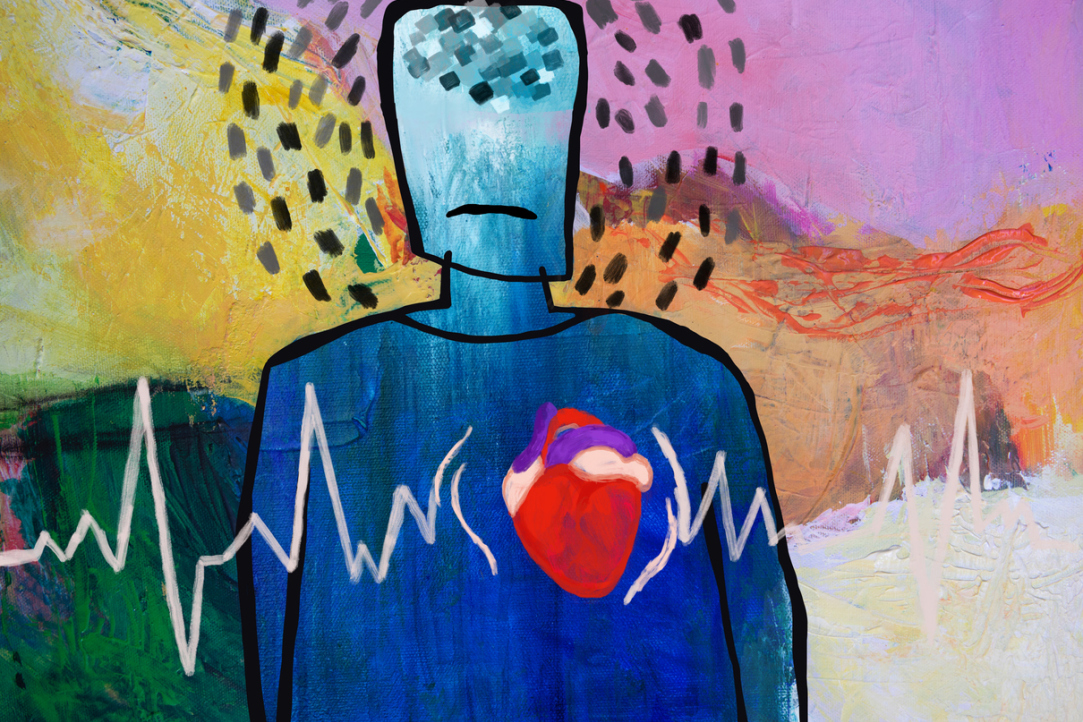
A group of scientists at HSE University have discovered how anxiety and depression can be diagnosed by analysing heart rate. It turns out that under mental stress, the heart rate of individuals with a predisposition to mental health disorders differs from that of healthy individuals, especially when performing more complex tasks. These changes in cardiovascular parameters can even be detected using a pulse oximeter or a smartwatch. The study findings have been published in Frontiers in Psychiatry.
According to the World Health Organization, one in five adults under the age of 30 suffers from depression or an anxiety disorder. To prevent the development of mental health conditions and treat them effectively, reliable personalised diagnostic methods are needed.
Today, many technology companies are developing mental health analysis systems based on heart rate data. Various wearable devices, such as smartwatches, bracelets, rings, and others, are used for this purpose. However, it is important not only to record changes in heart rate but also to interpret them accurately.
Scientists at HSE University, in collaboration with the Russian Academy of Sciences Institute of Higher Nervous Activity and Neurophysiology, conducted a study to determine whether signs of depression and anxiety can be detected through changes in heart rate during cognitive tasks. They performed an experiment with 90 subjects, aged 18 to 45, some of whom had a history of anxiety and depression episodes.
Participants completed memory and attention tasks that gradually increased in complexity: they were instructed to view images of coloured balls and compare each one with the previous one to identify colour matches. As the difficulty level increased, participants had to memorise more balls and colours.
During the experiment, participants' heart rates were recorded using an electrocardiogram (ECG), while simultaneously photoplethysmography (PPG) was conducted to analyse heart function based on changes in blood volume in peripheral vessels. This simple, non-invasive method allows data to be read from the finger or wrist; PPG is the technology used in all wearable devices today.

Data analysis revealed that individuals with higher levels of anxiety or depression exhibited more pronounced changes in heart rate, particularly during complex tasks.

'When faced with a challenging task, people experience stress. They can make mistakes, which is normal and does not necessarily indicate a mental health issue. However, at a critical point of increasing complexity—when the task is still manageable but requires maximum attention—individuals with signs of mental disorders exhibit a higher average heart rate, resulting in a more pronounced and distinct pattern of heart rate variability,' explains Evgeniia Alshanskaia, Junior Research Fellow at the Institute for Cognitive Neuroscience.
A key aspect of the experiment was the comparison of data obtained using EEG and PPG. Although EEG is traditionally regarded as a more reliable method for measuring heart rate variability, the study indicated that PPG might be a more sensitive tool for assessing depression and anxiety. The scientists attribute this to the specific characteristics of the sympathetic nervous system.
'Under stress, noradrenaline, which is linked to attention, is activated first, followed by the activation of adrenaline, which prepares the body for action and triggers the "fight or flight" response. Our heart rate increases, and our blood pressure rises. Noradrenaline also acts on receptors that induce vasoconstriction. At this stage, changes in the pulse wave can be observed using PPG. Only afterward is adrenaline released from the adrenal glands, which amplifies and prolongs the body's stress response, causing the heart to beat faster. Subsequently, changes are observed on the ECG. This indicates that PPG is a relatively reliable method that is also more accessible, faster, and informative compared to ECG,' according to Alshanskaia.
The study demonstrates that changes in heart rate in response to increasing cognitive load can serve as an early biomarker for anxiety and depressive disorders. Additionally, the findings from the experiment open new opportunities for developing algorithms for wearable devices and applications that can monitor a person’s psychological state in real time. Early, personalised, and non-invasive diagnosis of depressive and anxiety disorders through heart rate analysis could significantly transform the approaches to treatment and prevention of mental health conditions in the future.
The study was conducted within the framework of the Strategic Project 'Success and Self-Sustainability of the Individual in a Changing World' (Priority 2030 programme).
See also:

Scientists Test Asymmetry Between Matter and Antimatter
An international team, including scientists from HSE University, has collected and analysed data from dozens of experiments on charm mixing—the process in which an unstable charm meson oscillates between its particle and antiparticle states. These oscillations were observed only four times per thousand decays, fully consistent with the predictions of the Standard Model. This indicates that no signs of new physics have yet been detected in these processes, and if unknown particles do exist, they are likely too heavy to be observed with current equipment. The paper has been published in Physical Review D.
HSE Scientists Reveal What Drives Public Trust in Science
Researchers at HSE ISSEK have analysed the level of trust in scientific knowledge in Russian society and the factors shaping attitudes and perceptions. It was found that trust in science depends more on everyday experience, social expectations, and the perceived promises of science than on objective knowledge. The article has been published in Universe of Russia.
Scientists Uncover Why Consumers Are Reluctant to Pay for Sugar-Free Products
Researchers at the HSE Institute for Cognitive Neuroscience have investigated how 'sugar-free' labelling affects consumers’ willingness to pay for such products. It was found that the label has little impact on the products’ appeal due to a trade-off between sweetness and healthiness: on the one hand, the label can deter consumers by implying an inferior taste, while on the other, it signals potential health benefits. The study findings have been published in Frontiers in Nutrition.
HSE Psycholinguists Launch Digital Tool to Spot Dyslexia in Children
Specialists from HSE University's Centre for Language and Brain have introduced LexiMetr, a new digital tool for diagnosing dyslexia in primary school students. This is the first standardised application in Russia that enables fast and reliable assessment of children’s reading skills to identify dyslexia or the risk of developing it. The application is available on the RuStore platform and runs on Android tablets.
HSE Scientists Optimise Training of Generative Flow Networks
Researchers at the HSE Faculty of Computer Science have optimised the training method for generative flow neural networks to handle unstructured tasks, which could make the search for new drugs more efficient. The results of their work were presented at ICLR 2025, one of the world’s leading conferences on machine learning. The paper is available at Arxiv.org.
Physicists Propose New Mechanism to Enhance Superconductivity with 'Quantum Glue'
A team of researchers, including scientists from HSE MIEM, has demonstrated that defects in a material can enhance, rather than hinder, superconductivity. This occurs through interaction between defective and cleaner regions, which creates a 'quantum glue'—a uniform component that binds distinct superconducting regions into a single network. Calculations confirm that this mechanism could aid in developing superconductors that operate at higher temperatures. The study has been published in Communications Physics.
Neural Network Trained to Predict Crises in Russian Stock Market
Economists from HSE University have developed a neural network model that can predict the onset of a short-term stock market crisis with over 83% accuracy, one day in advance. The model performs well even on complex, imbalanced data and incorporates not only economic indicators but also investor sentiment. The paper by Tamara Teplova, Maksim Fayzulin, and Aleksei Kurkin from the Centre for Financial Research and Data Analytics at the HSE Faculty of Economic Sciences has been published in Socio-Economic Planning Sciences.
Larger Groups of Students Use AI More Effectively in Learning
Researchers at the Institute of Education and the Faculty of Economic Sciences at HSE University have studied what factors determine the success of student group projects when they are completed with the help of artificial intelligence (AI). Their findings suggest that, in addition to the knowledge level of the team members, the size of the group also plays a significant role—the larger it is, the more efficient the process becomes. The study was published in Innovations in Education and Teaching International.
New Models for Studying Diseases: From Petri Dishes to Organs-on-a-Chip
Biologists from HSE University, in collaboration with researchers from the Kulakov National Medical Research Centre for Obstetrics, Gynecology, and Perinatology, have used advanced microfluidic technologies to study preeclampsia—one of the most dangerous pregnancy complications, posing serious risks to the life and health of both mother and child. In a paper published in BioChip Journal, the researchers review modern cellular models—including advanced placenta-on-a-chip technologies—that offer deeper insights into the mechanisms of the disorder and support the development of effective treatments.
Using Two Cryptocurrencies Enhances Volatility Forecasting
Researchers from the HSE Faculty of Economic Sciences have found that Bitcoin price volatility can be effectively predicted using Ethereum, the second-most popular cryptocurrency. Incorporating Ethereum into a predictive model reduces the forecast error to 23%, outperforming neural networks and other complex algorithms. The article has been published in Applied Econometrics.