

Children with Autism Process Sounds Differently

For the first time, an international team of researchers—including scientists from the HSE Centre for Language and Brain—combined magnetoencephalography and morphometric analysis in a single experiment to study children with Autism Spectrum Disorder (ASD). The study found that children with autism have more difficulty filtering and processing sounds, particularly in the brain region typically responsible for language comprehension. The study has been published in Cerebral Cortex.
Autism, or Autism Spectrum Disorder (ASD), is a group of neurodevelopmental conditions that affect how a person perceives themselves, relates to others, and communicates. These conditions can vary widely, but people with ASD often have difficulty perceiving and processing sounds—for example, distinguishing speech in noisy environments, adapting to loud stimuli, or ignoring repetitive noises. Research indicates that these difficulties are linked to the functioning of the primary auditory cortex—the part of the brain’s temporal lobe responsible for basic sound processing. However, the precise ways in which auditory processing impacts language and communication in individuals with ASD remain poorly understood.
To explore the link between sound perception and language difficulties in children with ASD, researchers from the HSE Centre for Language and Brain, together with colleagues from Russia, the USA, and New Zealand, conducted a comprehensive study. They combined two methods: magnetoencephalography (MEG), which tracks brain activity in response to specific stimuli with millisecond precision, and morphometric analysis based on structural MRI data, which examines both the quantitative and qualitative features of the auditory cortex—such as its volume, thickness, and the shape of its gyri.
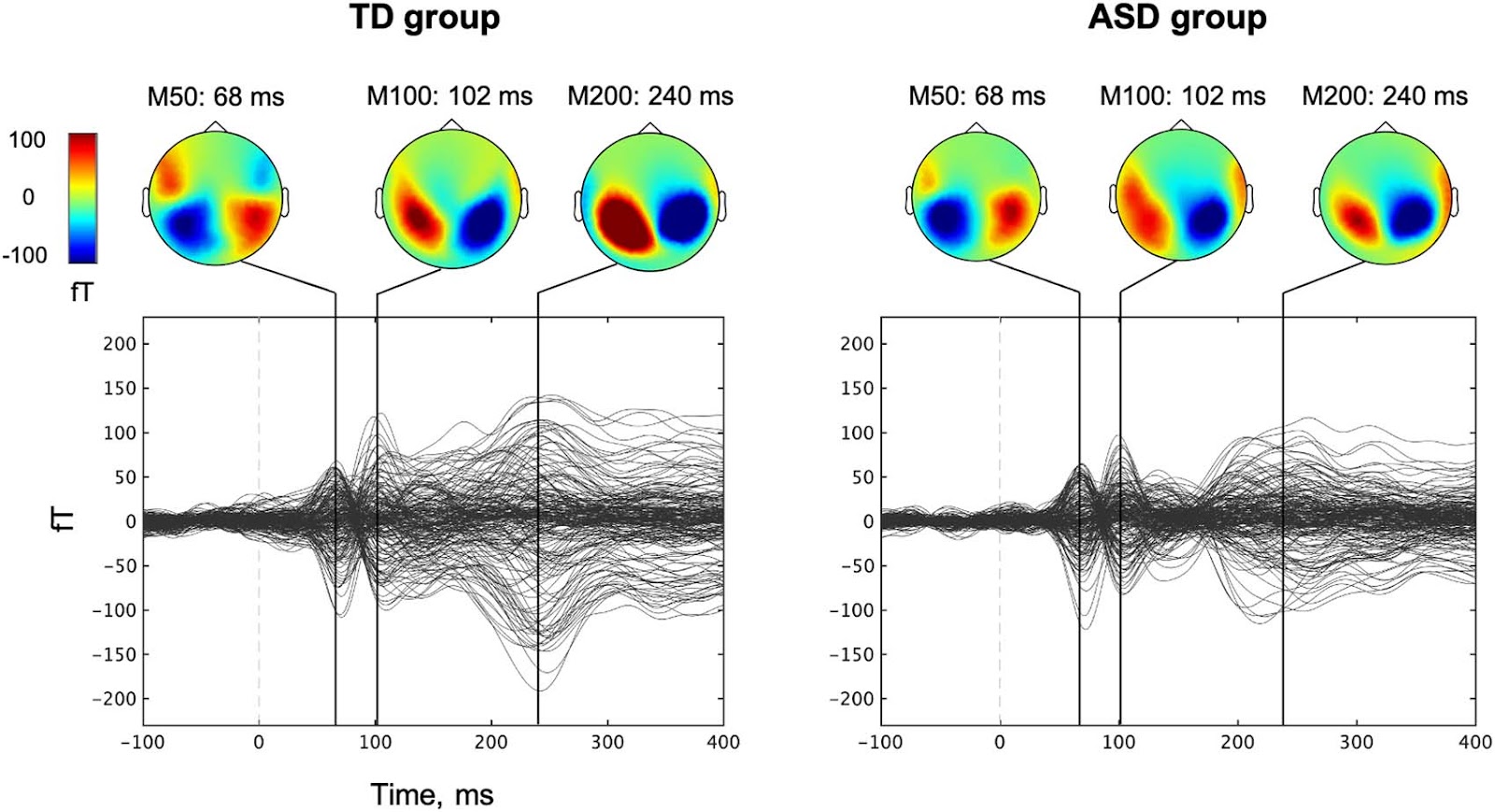
The study included 40 children—20 with typical development and 20 with a confirmed diagnosis of ASD. While the children listened to simple sounds—short clicks—scientists recorded their brain activity. The researchers focused on three components of the brain’s auditory response: M50, M100, and M200, which occur 50, 100, and 200 milliseconds after the sound is presented. Each of these components reflects a different stage of processing, ranging from basic perception to filtering and comprehension.
The most significant differences were found in the M200 component, which is involved in processing and filtering repetitive sounds. In children with ASD, this signal was significantly weaker, particularly in the left hemisphere, which is typically responsible for auditory perception and comprehension.
'We aimed to determine whether the perception of simple sounds is linked to language difficulties in children with ASD,' explains Olga Dragoy, Director of the HSE Centre for Language and Brain. 'Our results show that language difficulties in these children begin at a very early stage, when the brain first recognises and processes basic sounds.'
Anatomically, children with ASD exhibit two features: the auditory cortex in their left hemisphere is thinner, and the gyri are more curved and deeper. It was found that the more pronounced these differences, the greater difficulties children have with language comprehension and communication.

'The auditory cortex in the left, "linguistic" hemisphere helps children not only distinguish sounds but also learn to comprehend language and speak,' explains Alina Minnigulova, Research Fellow at the HSE Centre for Language and Brain. 'Perhaps it develops differently in children with ASD, which in turn affects their ability to comprehend language. Studying the relationship between auditory processing and language skills can aid in early diagnosis and the development of new educational and therapeutic approaches for children with ASD.'
The study was conducted with support from HSE University's Basic Research Programme within the framework of the Centres of Excellence project.
See also:

Scientists Test Asymmetry Between Matter and Antimatter
An international team, including scientists from HSE University, has collected and analysed data from dozens of experiments on charm mixing—the process in which an unstable charm meson oscillates between its particle and antiparticle states. These oscillations were observed only four times per thousand decays, fully consistent with the predictions of the Standard Model. This indicates that no signs of new physics have yet been detected in these processes, and if unknown particles do exist, they are likely too heavy to be observed with current equipment. The paper has been published in Physical Review D.
HSE Scientists Reveal What Drives Public Trust in Science
Researchers at HSE ISSEK have analysed the level of trust in scientific knowledge in Russian society and the factors shaping attitudes and perceptions. It was found that trust in science depends more on everyday experience, social expectations, and the perceived promises of science than on objective knowledge. The article has been published in Universe of Russia.
Scientists Uncover Why Consumers Are Reluctant to Pay for Sugar-Free Products
Researchers at the HSE Institute for Cognitive Neuroscience have investigated how 'sugar-free' labelling affects consumers’ willingness to pay for such products. It was found that the label has little impact on the products’ appeal due to a trade-off between sweetness and healthiness: on the one hand, the label can deter consumers by implying an inferior taste, while on the other, it signals potential health benefits. The study findings have been published in Frontiers in Nutrition.
IDLab: Fascinating Research, Tough Deadlines, and Academic Drive
The International Laboratory of Intangible-driven Economy (IDLab) was established at the HSE campus in Perm 11 years ago. Its expertise in data processing and analysis allows researchers to combine fundamental studies with applied projects, including the development of risk and cybersecurity models for Sber. The head of the laboratory, Professor Petr Parshakov, and Senior Research Fellow Professor Mariya Molodchik spoke to the HSE News Service about IDLab’s work.
HSE Psycholinguists Launch Digital Tool to Spot Dyslexia in Children
Specialists from HSE University's Centre for Language and Brain have introduced LexiMetr, a new digital tool for diagnosing dyslexia in primary school students. This is the first standardised application in Russia that enables fast and reliable assessment of children’s reading skills to identify dyslexia or the risk of developing it. The application is available on the RuStore platform and runs on Android tablets.
Physicists Propose New Mechanism to Enhance Superconductivity with 'Quantum Glue'
A team of researchers, including scientists from HSE MIEM, has demonstrated that defects in a material can enhance, rather than hinder, superconductivity. This occurs through interaction between defective and cleaner regions, which creates a 'quantum glue'—a uniform component that binds distinct superconducting regions into a single network. Calculations confirm that this mechanism could aid in developing superconductors that operate at higher temperatures. The study has been published in Communications Physics.
Neural Network Trained to Predict Crises in Russian Stock Market
Economists from HSE University have developed a neural network model that can predict the onset of a short-term stock market crisis with over 83% accuracy, one day in advance. The model performs well even on complex, imbalanced data and incorporates not only economic indicators but also investor sentiment. The paper by Tamara Teplova, Maksim Fayzulin, and Aleksei Kurkin from the Centre for Financial Research and Data Analytics at the HSE Faculty of Economic Sciences has been published in Socio-Economic Planning Sciences.
Mistakes That Explain Everything: Scientists Discuss the Future of Psycholinguistics
Today, global linguistics is undergoing a ‘multilingual revolution.’ The era of English-language dominance in the cognitive sciences is drawing to a close as researchers increasingly turn their attention to the diversity of world languages. Moreover, multilingualism is shifting from an exotic phenomenon to the norm—a change that is transforming our understanding of human cognitive abilities. The future of experimental linguistics was the focus of a recent discussion at HSE University.
Larger Groups of Students Use AI More Effectively in Learning
Researchers at the Institute of Education and the Faculty of Economic Sciences at HSE University have studied what factors determine the success of student group projects when they are completed with the help of artificial intelligence (AI). Their findings suggest that, in addition to the knowledge level of the team members, the size of the group also plays a significant role—the larger it is, the more efficient the process becomes. The study was published in Innovations in Education and Teaching International.
New Models for Studying Diseases: From Petri Dishes to Organs-on-a-Chip
Biologists from HSE University, in collaboration with researchers from the Kulakov National Medical Research Centre for Obstetrics, Gynecology, and Perinatology, have used advanced microfluidic technologies to study preeclampsia—one of the most dangerous pregnancy complications, posing serious risks to the life and health of both mother and child. In a paper published in BioChip Journal, the researchers review modern cellular models—including advanced placenta-on-a-chip technologies—that offer deeper insights into the mechanisms of the disorder and support the development of effective treatments.